Why AI Won't Replace You. But Recruiters Who Use It Will.
AI is reshaping recruitment faster than most teams can adapt. Six practical moves, backed by 2025 and 2026 data, to stay indispensable as a recruiter.
The numbers moved faster than the debate did. According to SHRM's 2025 Talent Trends research, 43% of organizations now use AI for HR tasks, up from 26% just one year earlier, and 89% of HR professionals using AI in recruiting say it saves them time. On the other side of the table, Gartner found that 39% of candidates already use AI during the application process.
So the question is no longer whether AI belongs in recruitment. It is what a recruiter does with the hours it gives back, and how to use it without outsourcing your judgment. Here are six practical moves.
1. Delegate the reading, keep the judgment
The first pass through a pile of applications is where AI earns its keep: parsing resumes, matching against requirements, producing a ranked shortlist. What it cannot do is weigh a career gap against a reference call, or read the room in a final interview.
Draw the line deliberately. Let tools handle volume and consistency; reserve your time for interviews, culture conversations, and the decisions themselves.
Next step: list the three tasks that eat most of your week. If any of them is repetitive reading or sorting, that is your first candidate for automation.
2. Learn to interrogate AI output
The most valuable new recruiter skill in 2026 is not prompting. It is auditing. When a tool ranks a candidate first, ask: what evidence supports that? Which requirement did it weigh most? Does it apply one fixed standard to every candidate?
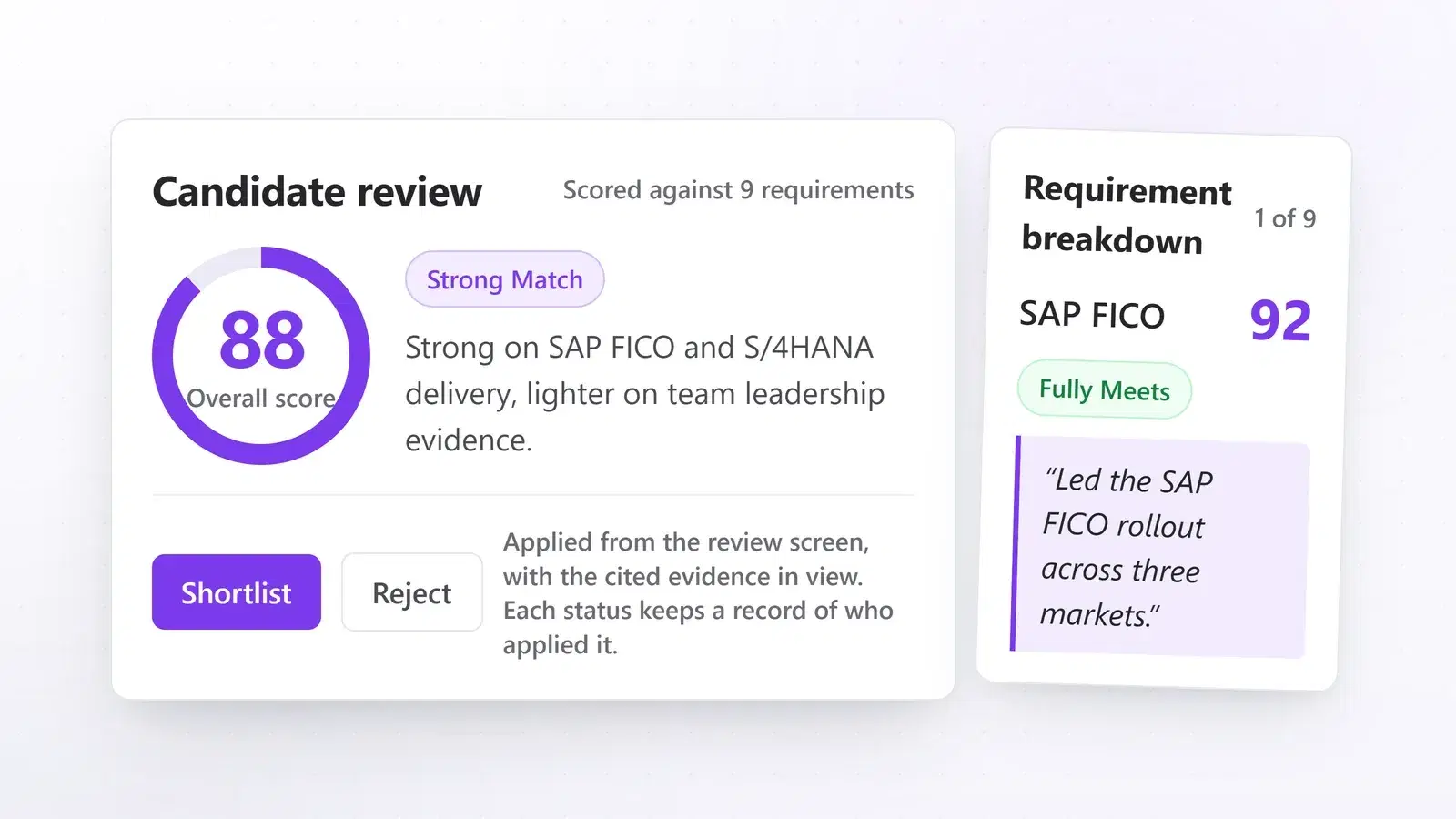
Tools differ enormously here. Some show you the reasoning behind every score; a general-purpose AI assistant will give you a fluent answer that can change on the next run. If you cannot see why a candidate ranked where they did, you cannot defend the shortlist to a hiring manager, or to a candidate who asks.
Next step: for your next role, pick one shortlisted and one rejected candidate and trace exactly why the tool placed them where it did. If you cannot, that is a tool problem worth escalating.
3. Get fluent in your own hiring data
Your funnel already contains the answers to most strategy questions: where good candidates drop out, which sources produce hires that stay, how long each stage really takes.
Next step: start tracking three numbers consistently:
- Conversion rate between each stage of your hiring process.
- Average time to hire, per role type.
- Retention at 6 and 12 months, by source.
Review them quarterly. Patterns in your own data beat any vendor benchmark.
4. Make ethics your professional edge
Algorithmic bias is real, and so is human bias. The recruiters who thrive will be the ones who can explain, to a candidate, a hiring manager, or a regulator, how their process works and why it is fair.
This is becoming law, not just good practice: the EU AI Act classifies AI systems used in recruitment as high-risk, with obligations for the companies deploying them phasing in from August 2026 (see the European Commission's AI Act overview). Transparency, human oversight, and record-keeping are moving from nice-to-have to required.
Next step: prefer tools that show their reasoning, apply the same criteria to every candidate, and keep an audit trail of decisions. If a vendor cannot explain how a score is produced, treat that as your answer.
5. Upskill on AI applied to recruitment
Understanding how matching and scoring work does not require a data science degree. Free and low-cost micro-courses on AI in HR exist on LinkedIn Learning and AIHR, and the vocabulary you pick up compounds: you will evaluate vendors better, spot inflated claims faster, and explain your process more credibly.
Next step: block two hours this month for one micro-course on AI in recruiting. Take notes on the questions you would now ask your current tools.
6. Stay experimental
The tools will keep changing. The durable advantage is a habit: try, measure, keep what works, drop what does not.
Next step: subscribe to one specialized newsletter such as Recruiting Brainfood and test one new workflow per quarter, with a before-and-after measure you defined in advance.
The bottom line
Recruiters will not be replaced by software. But recruiters who treat AI as a threat will be outpaced by recruiters who treat it as a capable junior colleague: fast, tireless, and in need of supervision. The judgment, the relationships, and the accountability stay with you.
If you want to see what supervised AI screening looks like in practice, Talentino scores every candidate against your requirements and shows the evidence behind each score, so the final call stays yours, with reasons you can defend. Start free, no credit card required.