Fake Candidates and AI-Written Resumes: A Verification Checklist for 2026
Gartner predicts 1 in 4 candidate profiles will be fake by 2028, and the FBI has been warning about deepfake applicants since 2022. A stage-by-stage verification checklist, from resume consistency reads to interview probes to day-one access, that catches fabrication without treating every real candidate as a suspect.
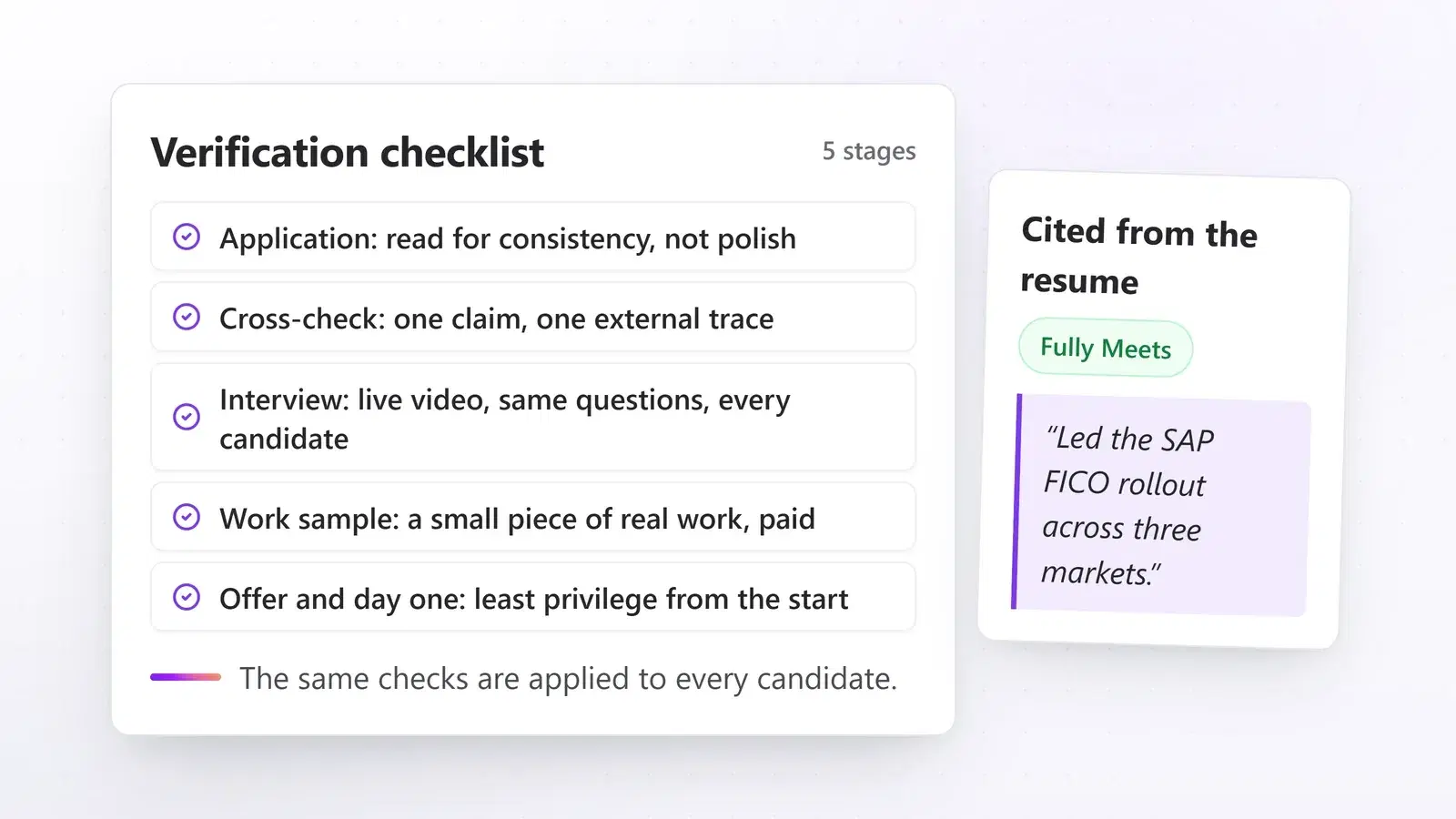
Start with the numbers, because they are stranger than the headlines. Gartner predicts that by 2028, one in four candidate profiles worldwide will be fake. In its survey of 3,000 job candidates, 6 percent admitted to interview fraud: posing as someone else, or having someone else pose as them. The FBI has been warning since 2022 about deepfakes and stolen identities used to apply for remote roles. And in June 2025 the US Department of Justice announced coordinated actions against North Korean remote-IT-worker schemes, including searches of 29 "laptop farms" across 16 states, real addresses hosting company laptops so overseas operatives appear to be working domestically.
Before the checklist, one calibration, because it decides whether your process stays fair. "Fake" spans three very different things:
- AI-assisted applications. In the same Gartner research, 39 percent of candidates said they used AI in their application, mostly to write resume or cover letter text. This is polish, not fraud. Treat it as the new normal.
- Inflated applications. Real people, fabricated claims: invented skills, stretched dates, project credits that do not hold up. This is the classic problem, now produced at AI speed and AI fluency.
- Synthetic candidates. The person does not exist, or is not who they claim to be: stolen identities, stand-in interviewees, real-time deepfake video. Researchers at Palo Alto Networks' Unit 42 showed that building a passable real-time deepfake interview setup took just over an hour, with no prior experience and cheap consumer hardware.
Tier 1 needs no defense. Tiers 2 and 3 are what the following checklist is for. It follows your funnel, because the cheapest catch is always the earliest one.
Stage 1: The application. Read for consistency, not polish
Fluency stopped being a signal the day everyone gained a fluent ghostwriter. Consistency is much harder to fake, because a fabricated career has to lie coherently across every section:
- Do the dates add up? Overlapping full-time roles, degrees that collide with jobs on other continents, seniority that arrives faster than the career could deliver it.
- Does the trajectory make sense? Titles, scope, and stack should progress like a real career. A "principal engineer" whose prior role was two years of junior work is a question to ask, not proof of anything.
- Is the specificity real? Fabricated experience tends toward generic accomplishment language. Real experience names systems, constraints, and trade-offs. Flag resumes where every project is described from 10,000 feet.
- Check the mundane details. Brand-new email addresses, phone numbers that do not match any claimed location, and location claims that shift between resume, profile, and application form are all classic markers noted in the FBI's guidance.
If you screen with software, this is also where a manipulation-resistant pipeline matters; we covered the tactics, from keyword stuffing to prompt injection, in 5 ways candidates game AI recruitment tools.
Stage 2: The cross-check. Does this person exist beyond the PDF?
Ten minutes per serious candidate, before you spend an hour interviewing them:
- Profile age and texture. A LinkedIn profile created three months ago with 40 connections and no history attached to any claimed employer deserves a question. So does a profile whose photo returns stock-image results on a reverse image search; the fake engineer who nearly infiltrated the security company KnowBe4 used an AI-modified stock photo.
- Repository evidence, read rather than counted. For technical roles, a GitHub with years of scattered, imperfect commit history looks nothing like one padded last month. Open two or three repos. Real work has code review, dead ends, and unglamorous fixes.
- One claim, one external trace. Pick the biggest claim on the resume and look for any independent trace of it: a conference talk, a changelog, a team page, a co-author. Absence proves nothing, but presence is cheap confirmation.
Stage 3: The interview. Structure beats intuition
- Live video, camera on, stated in advance. Synthetic candidates concentrate where verification is weakest, and they route around processes that never put a face on screen. Candidates broadly accept this: in another Gartner survey, 62 percent said they were more likely to apply to a job that required in-person interviews.
- Anchor questions to the resume, then go one level deeper. "Walk me through the migration you led. What broke first? What would you do differently?" A candidate who lived it answers with specifics and trade-offs. A scripted candidate, human or AI-fed, goes generic exactly one follow-up deep.
- Watch the seams, politely. The FBI's deepfake advisory points at lip-sync and audio misalignment, and Unit 42 notes that cheap real-time deepfakes still fail at occlusion: a hand passing in front of the face, turning fully sideways. You do not need an interrogation; a natural "sorry, could you adjust your camera?" moment tells you plenty.
- Same questions, every candidate. Structured interviews are not just fairer; they make the fabricated answer stand out, because you have heard fifteen real answers to the same question.
Stage 4: The evidence. A small sample of real work
A short, paid work sample, or a live collaborative session on a realistic problem, is the single most fraud-resistant step available, because it tests the one thing that cannot be borrowed on the spot. Keep it small and respectful of the candidate's time. For tier 2 fraud, this is where inflation collapses. For tier 3, live collaboration with camera and conversation compounds every check above.
Stage 5: Offer and day one. Verify, then trust gradually
- Identity verification consistent with local law, done post-offer, when it is proportionate and expected.
- Watch the logistics. Equipment shipping addresses that do not match the claimed residence are the signature of the laptop-farm scheme in the DOJ actions above.
- Least privilege on day one. KnowBe4's own retelling is blunt: what saved them was not the hiring funnel, it was that new hires start in a restricted environment and the malware tripped monitoring within minutes. Onboarding access policy is the last line of hiring verification.
Keep the process worth trusting
One number to keep beside all the others: in Gartner's survey, only 26 percent of candidates trust that AI will evaluate them fairly, and there is evidence that opacity itself pushes candidates toward gaming. Verification that feels like suspicion drives away exactly the real candidates you are competing for. Disclose how your process works, apply the same checks to everyone, and keep humans visibly in the conversation. The goal is a process where fabrication is expensive and honesty is easy.
Where Talentino fits, honestly
Talentino is a screening platform, not an identity-verification service; stages 2 through 5 above are human and process work no scoring engine does for you. What it contributes is the evidence layer that makes those stages cheaper. Skills, technologies, soft skills and industries carry a citation back to the line in the resume that supports them, so an inflated claim has to survive a human reading the quote, and your stage 3 anchor questions are already written. Scoring is deterministic by design: the same criteria and the same weighting are applied to every candidate, with safeguards against manipulation attempts like keyword stuffing and prompt injection built into the pipeline. And the candidate record keeps its own history: capture a candidate from LinkedIn with Talentino Scout and their profile URL is saved on their record, alongside the resume, and from there the details you and your team add are kept with their history, which gives your stage 2 cross-check a head start instead of a blank page. Start free and see the evidence behind every score on a real role, or book a demo.