AI in Recruitment: How Tech Companies Hire Smarter in 2026
AI in recruitment is not replacing recruiters, it is changing where their time goes. How tech companies use AI across the hiring funnel, what the 2025-2026 data shows, and the four risks to manage.
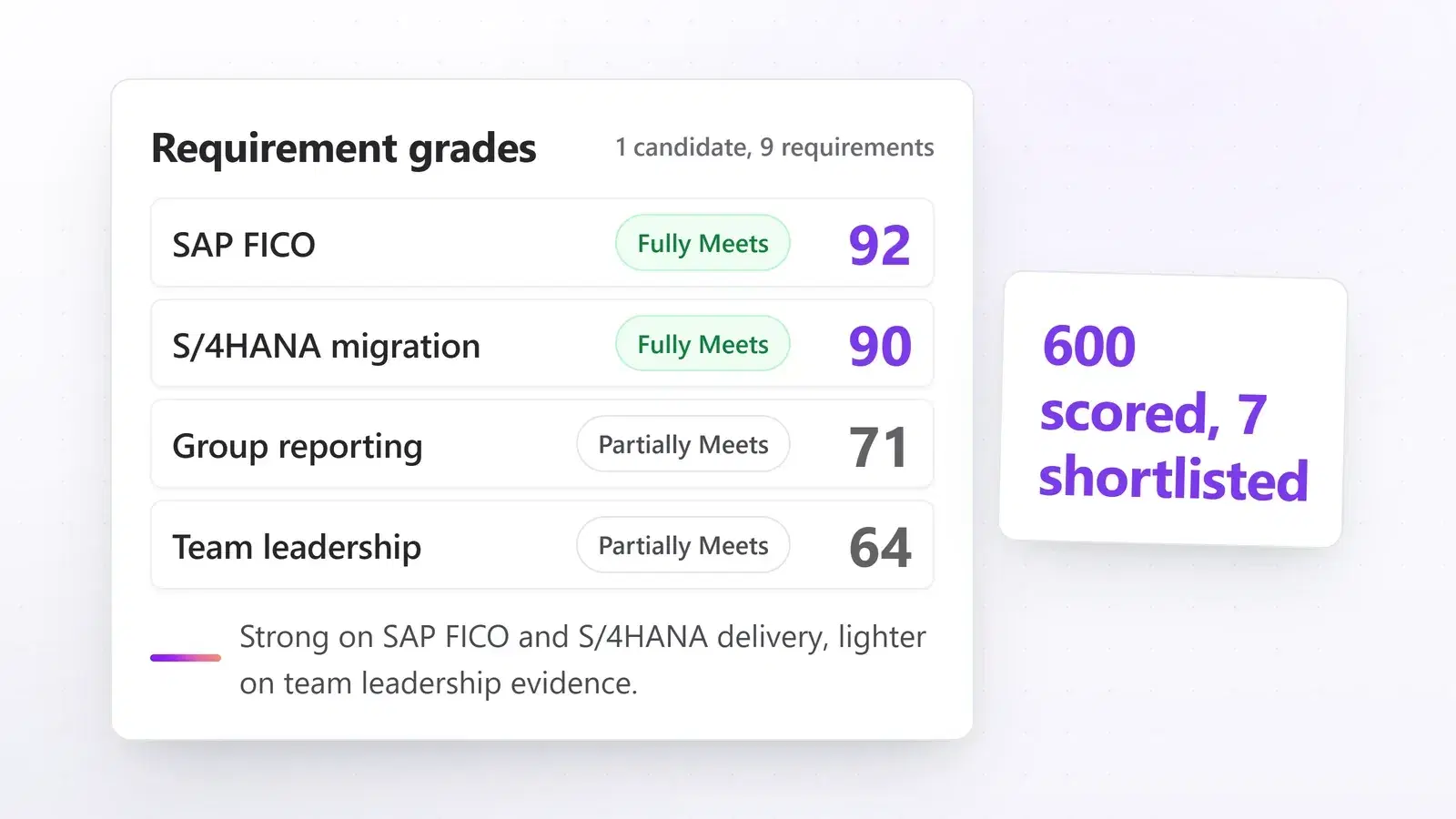
AI in recruitment is not replacing recruiters. It is changing where their time goes: away from reading and sorting, toward interviews, offers, and decisions. Tech companies adopted this shift first, and their experience is a useful preview for everyone else.
In this guide: where AI actually delivers value across the hiring funnel, what the data says, and the four risks worth managing in 2026.
Why tech companies were first to adopt AI in recruitment
Tech companies run on data-driven decisions, and hiring speed directly affects product velocity and revenue. Four pressures pushed them to move first:
- Application volume. Popular engineering and data roles attract far more applications than a human can read carefully. LinkedIn reported applications surging more than 45% year over year, at points reaching around 11,000 applications per minute on the platform.
- A persistent talent shortage. Roughly three-quarters of employers report difficulty finding the skilled talent they need, which rewards teams that evaluate fast and well.
- Top candidates disappear in days. Slow processes lose the best people to faster competitors.
- Comfort with the technology. Teams that build software all day extend more informed trust, and more informed scrutiny, to software in their own workflows.
The adoption curve is steep across the whole market now, not just tech: SHRM's 2025 Talent Trends research found 43% of organizations using AI for HR tasks, up from 26% one year earlier, with resume screening among the top use cases.
Where AI works across the hiring funnel
Resume screening and candidate matching
The highest-leverage stage. AI reads every incoming resume and scores it against the role's requirements, so recruiters open a ranked, explained shortlist instead of a raw pile. The critical property to demand here is transparency: a score you cannot trace to evidence is a score you cannot defend to a hiring manager or a candidate.
Scheduling and routine communication
Assistants and automated messaging tools absorb the back-and-forth of interview scheduling and answer routine candidate questions. Unglamorous, and one of the clearest returns on investment: this is pure coordination time recovered every single week.
Assessment at scale
Structured, consistent assessment across thousands of applicants is where large employers report the clearest gains. The best-documented example remains Unilever's AI-supported assessment program, which cut recruitment time dramatically while saving over £1 million per year. The lesson generalizes: consistency at a scale humans cannot sustain manually.
A caution belongs here. Some vendors market models that claim to forecast which candidates will succeed or stay long-term. Treat those claims with scrutiny: ask what data the model was trained on, how the forecast is validated, and what happens to candidates it scores down. If a vendor cannot answer, the claim is marketing, not measurement.
Reducing unconscious bias, with conditions
AI can standardize evaluation: same criteria, same weighting, applied identically to every candidate. That is a genuine path toward more consistent hiring, but it is conditional, not automatic. It requires representative data, regular audits, and human oversight. Standardization without scrutiny just automates the existing bias.
Better, not just faster
Speed is the visible benefit; decision quality is the compounding one. LinkedIn's 2025 Future of Recruiting report found that companies making the most use of AI-assisted messaging are 9% more likely to make a quality hire than those using it least, and that 73% of talent professionals agree AI will change how companies hire.
In practice, the division of labor is straightforward: AI handles the data-heavy lifting (screening, ranking, scheduling), and recruiters spend the reclaimed time on judgment, relationships, and closing. The output of the machine is an input to the human.
What to watch out for
- Candidate trust. Pew Research Center found that 66% of Americans would not want to apply to an employer that uses AI to help make hiring decisions, and a 2025 Gartner survey found only 26% of applicants trust AI to evaluate them fairly. Transparency about where AI is used, and where humans take over, is the working answer.
- Algorithmic bias. Models trained on skewed history reproduce it. Continuous monitoring, representative data, and audits are the mitigation, and under the EU AI Act, hiring AI is classified high-risk, with deployer obligations phasing in from August 2026.
- Candidates gaming the systems. As screening automates, some candidates optimize for the algorithm rather than the job. We covered the five most common tactics, and the defenses, in our article on candidates gaming AI recruitment tools.
- Over-automation. Removing humans from decisions backfires with candidates and regulators alike. The durable pattern: AI output is advisory, decisions are made by people, and status changes are recorded so the process can be audited afterward.
The bottom line
Tech companies did not adopt AI in hiring because it was fashionable. They adopted it because application volume outgrew manual reading, and they kept it because consistent, explained screening made their decisions better as well as faster. Used with the guardrails above, it does the same for any team drowning in applications.
See it in practice
Talentino applies this model end to end: every candidate scored against your requirements, every score explained with evidence quoted from the resume, and shortlist or reject decisions applied by you from the review screen, with each status keeping a record of who applied it. Start free, no credit card required, or book a demo.