How to Screen 200 Applications Without Reading Every Resume Twice
LinkedIn now clocks thousands of applications per minute, and most hirers say fewer than half meet the role's criteria. A five-step triage workflow that touches each application once, with a decision attached, whether you screen with a spreadsheet or a tool.
The pile is not your imagination. The number of applications submitted on LinkedIn surged more than 45 percent in a year, and The New York Times reported the platform averaging 11,000 applications per minute. One HR consultant in that story posted a remote tech role and had 400 applications in 12 hours, more than 1,200 within days. And the volume is not matched by fit: in a LinkedIn survey reported by CNBC, 70 percent of hirers said fewer than half of the applications they receive meet all the criteria for the role, while over a fifth of HR professionals spend 3 to 5 hours a day just going through applications.
So take a realistic scenario: one role, 200 applications, and a hiring manager who wants a shortlist this week. The failure mode is familiar. You skim everything once to "get a feel", flag 40 maybes, then read the maybes again properly, and by resume 150 of the first pass your criteria have drifted so far that the person you rejected at 9 a.m. would have passed at 4 p.m.
The fix is one principle: touch each application once per stage, with a decision attached. Reading without deciding is the double-reading machine. Here is the workflow, in five steps. It works with a spreadsheet; it works better with a screening tool; the logic is identical.
Step 1: Write the requirements before you open a single resume
Every re-read traces back to the same root cause: criteria decided during the reading instead of before it. So before opening any application, turn the job description into an explicit list:
- Must-haves: the 2 to 4 requirements a candidate genuinely cannot succeed without. Be honest here. If you would interview a great candidate who lacks it, it is not a must-have.
- Weighted nice-to-haves: 4 to 6 requirements that make a candidate stronger, each phrased so you could point at evidence for it. "5+ years building consumer mobile apps" is checkable; "rockstar mentality" is not.
Write them down where the whole hiring team can see them. This list is your contract with yourself; every later decision points back at it. It is also, increasingly, what regulators expect you to be able to show; consistent, pre-defined criteria are the backbone of a defensible process.
Step 2: The deal-breaker pass
First pass through all 200: check must-haves only. Nothing else. No impressions, no "interesting profile", no rabbit holes. A candidate either shows evidence of each must-have or does not, and the ones who do not get a decision (out), a reason (which must-have), and a place (a "declined: missing X" column, not a trash can; you will want the record).
Done honestly, this pass is fast, 30 to 60 seconds per application, because you are answering 3 binary questions, not forming an opinion. On a typical pile it removes half or more. You now have perhaps 60 to 80 candidates, each already touched once with a decision attached.
Step 3: The scored pass
Second pass, survivors only: score each candidate against the weighted requirements. In a spreadsheet, that is one row per candidate, one column per requirement, 0 to 2 in each cell (0 no evidence, 1 some, 2 strong), weights applied at the end. Crude, but it forces the thing that matters: the same questions asked of every candidate in the same order, so candidate 61 is judged by the same standard as candidate 3.
This is the step where software earns its keep, because scoring 60 resumes by hand is exactly the tedious, consistency-critical work machines are for. This is now mainstream: SHRM's 2025 Talent Trends research found 44 percent of organizations already using AI to screen resumes, and 89 percent of HR professionals who use AI in recruiting say it saves them time. But if you use a tool here, hold it to the standard the spreadsheet sets. Ask three questions of any vendor:
- Is the scoring consistent? Does it apply one fixed standard to every candidate, the same criteria and the same weighting, or does it read each resume fresh and form a new opinion? If the standard moves, your 4 p.m. problem is back, just automated.
- Can it explain each score? A ranked list with no reasons pushes you back to re-reading, which was the problem.
- Does it show evidence? A claim like "strong Python background" should come with the resume lines that support it, so checking a score does not mean reopening the PDF.
Step 4: The evidence-checked review
You now have a ranked list. Third and final pass: read the top slice, and only the top slice, properly. For a shortlist of 5, that usually means reading 15 to 25 candidates deeply, not 200.
"Properly" means verifying, not admiring. For each top candidate, check the scored claims against the underlying evidence: does the trajectory support the seniority? Do the dates add up? Is the flagship project described with the specificity of someone who did it? Polished, keyword-perfect resumes are now the default output of AI tools, in a Gartner survey 39 percent of candidates said they used AI in their application, so fluency is no longer signal. Evidence is. (If verification is a live concern for your roles, we cover the manipulation side in how candidates game AI recruitment tools.)
Take structured notes against your requirement list as you go. They become your interview plan and your answer when the hiring manager asks "why not this one?".
Step 5: Close the loop, and keep the record
Two cheap habits with outsized returns. First, respond to everyone quickly, including the declined; candidates talk, and slow silence is the most common way a good employer brand leaks. Second, keep the record of what was decided and why at each pass. It settles internal debates, it protects you when a decision is challenged, and if you hire in the EU it is the raw material for obligations that are arriving on a schedule (we cover those in our EU AI Act guide for hiring teams).
The same workflow, with the reading done for you
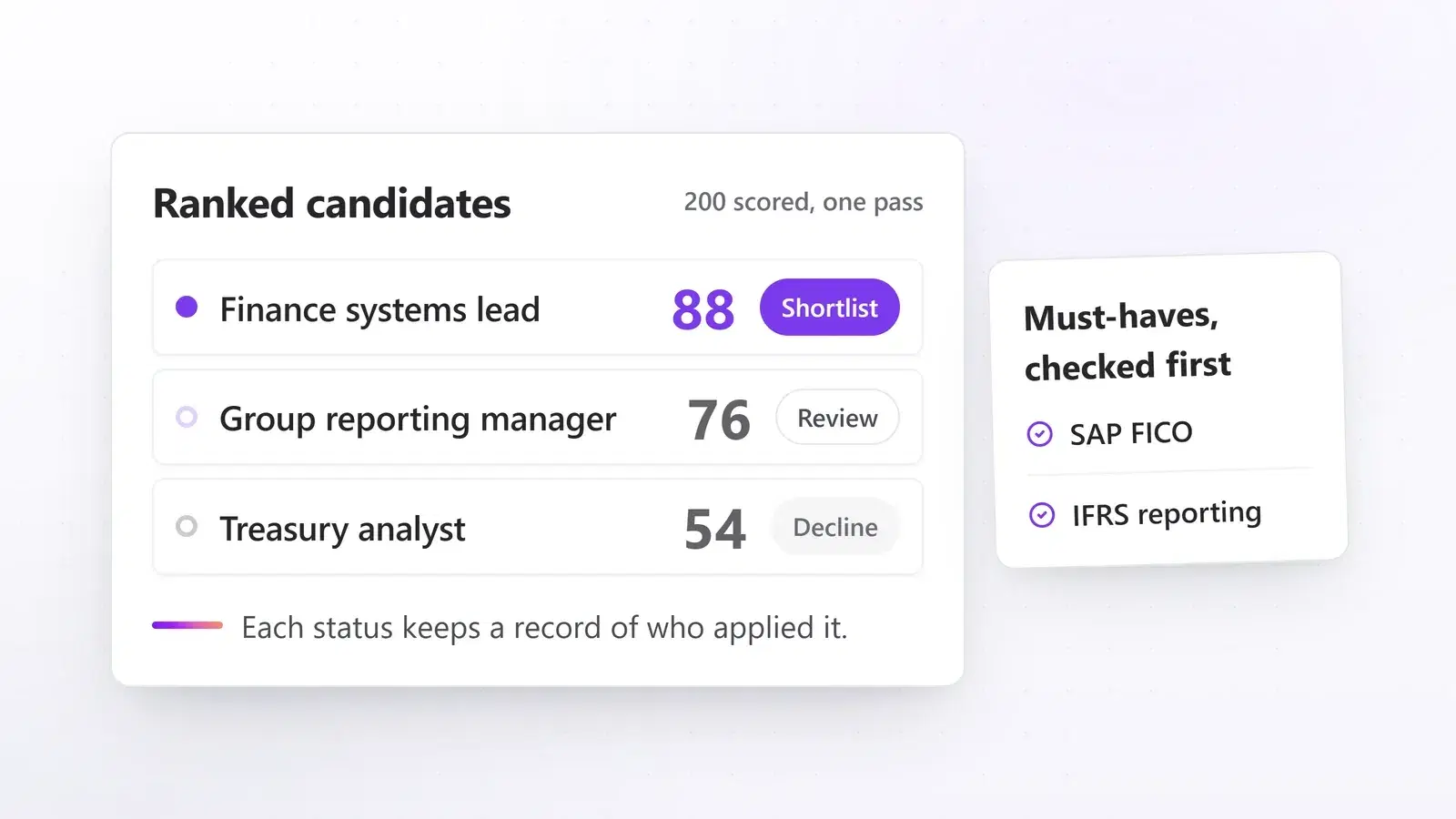
Talentino runs this exact shape of process. You paste the job description and it extracts the requirements; you mark your must-haves and set the weighting across the scoring criteria yourself, or leave each category's default in place. Every candidate comes back scored and ranked, and the scoring engine is deterministic by design: the same criteria and the same weighting are applied to every candidate, so the standard cannot drift between resume 3 and resume 161. Each score opens into a per-requirement breakdown with the supporting lines quoted from the resume, which turns your evidence-checked review from re-reading into checking. Shortlist and decline are applied from the review screen, with the evidence in view, and each status keeps a record of who applied it. Start free and put your next 200-application role through it, or book a demo. If you are still choosing your stack, our guide to HR screening software for small businesses covers what to check before committing.